What's New
2022 Presentation for PHCP (9-19-23) Pete Ramey
#1) Understanding "Sinkers" and Hoof Capsule Rotation
PDF handout 1: Understanding "Sinkers" and Hoof Capsule Rotation
#2) Reversing Hoof Capsule Rotation and Distal Descent (Sinking)
PDF handout 2: Reversing "Sinkers" and Hoof Capsule Rotation
Care and Rehabilitation of the Equine Foot is available in hardcover.
Handouts for March 26-27, 2022 PHCP Webinar
2020
Our 2020 clinic schedule
2020
Pete is giving two presentations at the 2020 American Farriers Association Convention
May 20, 2017 article; updated 2019
New article Modifications of Easyboot Gloves and Glue-On Shells is an important update to ALL of our books, articles and DVD sets. More
August 2018 - I have just finished a big update of the articles here http://www.hoofrehab.com/Articles.html
2017
2017 Clinic Schedule is posted including:
Perkasie, PA - Tooele, UT - Prince George, BC - Ledyard, CT - Justin, TX - Taos, NM Click here for more information.
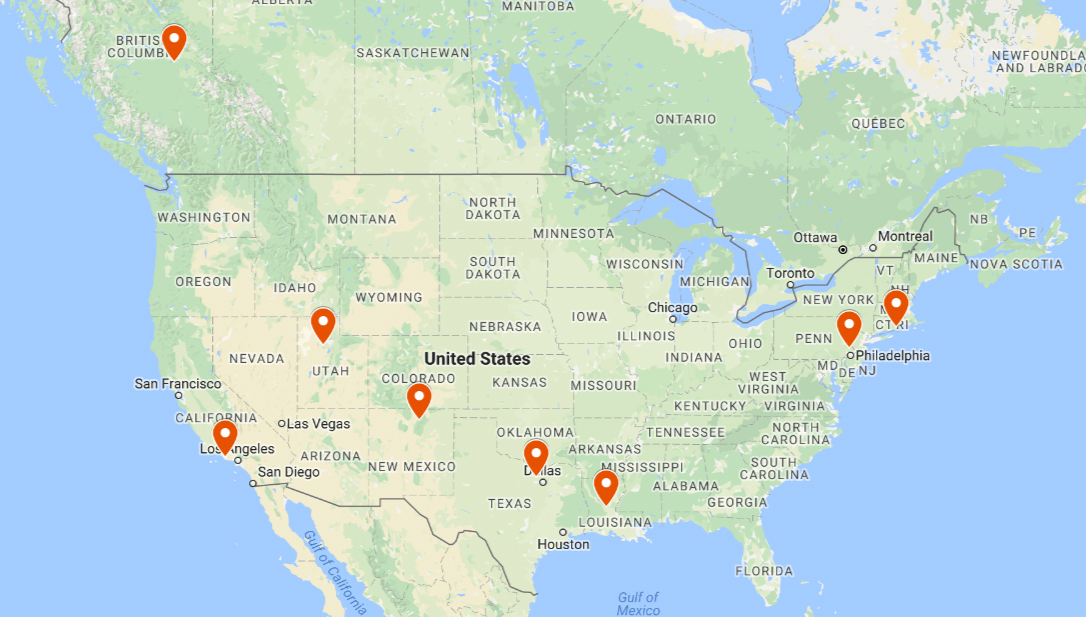
4-08-2016 Beginning in summer 2016 Ivy, Pete and family are planning two-day clinics around the US and abroad. Clinics are limited to 43 participants, so sign up early.
From the January 2016 archive
Coming Soon From Easycare?

Wanna race? This new tread pattern is likely to revolutionize turf and arena sports--and make some folks happy who like to trail ride in mud, snow, and sand. Hopefully available soon in the Easyboot Glove and Glue-On, it features a domed sole to maximize "bite," while keeping the profile as compact as possible. This boot tread is designed to resist clogging, so that the horse doesn't have to carry the weight off the dirt, and so that each step gets the traction advantage of a clean tread. Optional studs can be nipped off if not needed.
3-18-2015 We are now posting our 2015 Workshop schedule approximately six months in advance. Participant slots are on sale now.
Workshops 2015
Workshops 2015
11-14-2014. Ivy is currently planning the schedule for our 2015 Hoof Rehab Workshop tour. She will assemble a list of potential hosts, and then attempt to link them together into a reasonably efficient route around the US, starting in June 2015 and ending in February 2016. If you are interested in hosting a Workshop, please read all of the links and sections of http://www.hoofrehab.com/PeteRameyWorkshops.html (Workshop info, host info, participant info…) and then register as a potential host at http://www.hoofrehabstore.com/workshop-host-reg/?sort=pricedesc . We look forward to meeting you and your horses!
Study published April 2014
New Research from Auburn University
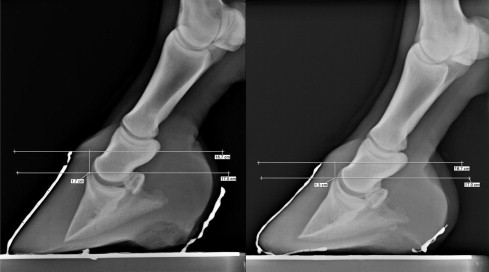
Clinical Outcome of 14 Obese, Laminitic Horses Managed with the Same Rehabilitation Protocol
Abstract
A specific method of rehabilitation was used to manage obese horses with laminitis, and clinical outcome was evaluated after 5 to 20 months. Clinical data from 14 similar laminitis cases were statistically analyzed to evaluate response to rehabilitation. Data were analyzed using repeated measures or logistic regression methodologies. Each horse presented as obese and laminitic with no history of a systemic inflammatory disease. The rehabilitation method emphasized a mineral-balanced, low nonstructural carbohydrate diet; daily exercise; hoof trimming that minimized hoof wall loading; and sole protection in the form of rubber hoof boots and/or hoof casts. Distal phalanx alignment within the hoof capsule was significantly improved, and hoof wall thickness was significantly decreased (P < .0001) following treatment. Solar depth was significantly increased (P < .0015). Reduction of palmar angle measurements was detected in acutely and chronically affected horses. This treatment effect was statistically greater for horses with chronic laminitis than for horses with acute laminitis (P interaction < .0001). Horses were 5.5 times more likely to be sound post-treatment than before treatment. Daily exercise, dietary modification, and removal of ground reaction force from the hoof wall were foci of the rehabilitation program. Hoof care and husbandry as applied to these horses may be an effective method of rehabilitation of horses from obesity-associated laminitis. Link to entire paper
.
2014
Workshops 2014
Ivy and Pete are hitting the road in the summer of 2014. They plan to tour the US teaching small (8 horse, 15 person) practical workshops to horse owners and professionals.
We are starting to post workshop dates and locations (more to come soon) and sign-up is now open. Only 5 guests per workshop, so don’t think about it too long. As they fill up, keep an eye on the schedule for new workshops to pop up. More
Original homepage announcement
Ivy and Pete are hitting the road in the summer of 2014. They plan to tour the US teaching small (6 horse, 15 person) practical workshops to horse owners and professionals.
2010-2014 Tevis and Haggin Cup highlights
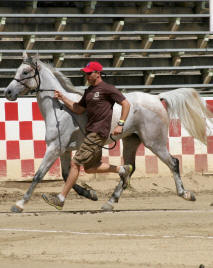 Congratulations Garrett, Fury and Easyboots-
Haggin Cup Winners!
And in 2011 and 2012...
And 2014...
2014 · Tevis Cup
Once again, Easyboots dominated the Tevis Cup. First Place, Best Condition, and 10 of the top 15 wore Easyboots. More
In our archives by December 2013
P3 and P2 Development
While equine researchers continue to laugh at the idea that increased movement may play a part in development of the foot, bovine researchers are stepping up to the task. In this study, the size of P3 and P2 was increased by allowing more movement on rocky terrain for four months. More
In our archives by December 2013
Digital Cushion Development
Once again, researchers in the dairy industry have stepped up to the challenge of studying foot development. The control group of calves was kept in a small enclosure, while the treated group was walked two miles daily. More
In our archives by December 2013
Auburn Study: Caudal Foot Evaluation
Predictive modeling of the equine heel
Recently it has been proposed that healthy soft tissue structures of the equine heel play a primary role in equine soundness. Historically, little attention has been given to the significance of the health of the equine heel soft tissue structures, which are uniquely positioned so as to provide support and protection to the navicular apparatus. More
November 10, 2013 · championship
Congratulations Matrix, Akiko, Sossity, Mario and Easyboot Gloves!
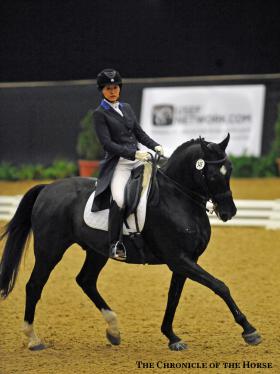
Congratulations Matrix, Akiko, Sossity, Mario and Easyboot Gloves! They swept the Prix St. Georges and are National Champions.
Starting with the April '13 issue, I will be writing a monthly Q&A piece for Horseback Magazine.
February 2013 · magazine article
Dressage Today article
2013
New (2013) Articles by Pete Ramey
written for Horseback Magazine. Links to online version of magazine and copies on this site here.
August 19, 2012 · research appeal
Important research project needs your help now!
May/June 2012 · book review
American Farriers Journal book review
2012 · Tevis Cup
Check out these hoof boot stats for the Tevis Cup
(the world's best known and most difficult equestrian endurance ride).Easyboots at Tevis Congratulations everyone!
Sure to be an excellent equine nutrition clinic:
https://www.nolaminitis.org/first-annual-no-laminitis-conference August 5-7 2011
DVD available by August 2011
New DVD set Donkey Hooves: Inside and Out
January 24, 2011 statistics update
Updated statistics from Dr. Taylor with 26 horses in the laminitis study
2011 · textbook publication
New book Care and Rehabilitation of the Equine Foot available for immediate shipment.
Preparing the 2011 textbook for publication
Well, the new book is finally done.
Color hardback, 8 authors, designed for veterinarians, farriers and trimmers- detailed focus on laminitis and caudal foot pain. Read outline at: Care and Rehabilitation of the Equine Foot Pre-sale open for November shipment.
New article October 1, 2010 Hoof Care in the 21st Century?
DVD available by October 2010
New DVD set In The Trenches
DVD available by May 2010
New 2 disc DVD set That's My Horse #3
DVD available by November 2009
New 3 disc DVD set That's My Horse #2
DVD available by July 2009
New 3 disc DVD set That's My Horse #1
March 14, 2009 · case-work update
Ivy and Pete Update Auburn U case documentation
2009 · research presentation
3D Reconstruction poster AU
Adam Cooner LC/DC study at AU PowerPoint presentation. Special thanks to Easycare for funding this project!!! This is a very important step towards studying and evaluating LC and DC development in live horses. Cool and informative 3d MRI and CT models. (Use left and right arrows to speed up or slow down transitions and animations) (slide #25 is a great animation that few computers can play for some odd reason- sorry) Dial-upers and dinosaur jockeys beware: This is a BIG file. write-up in development
2009 · protocol
Hoof Rehab Protocol in the 'Articles' section
The "Under the Horse" DVD set has been approved by the American Association of Veterinary State Boards (AAVSB RACE) for 20 hours CE Credit for vets and vet techs (testing and critique of the course also required to complete CE requirements)
May/June 2008
A very special "Thank you" to the American Farriers Journal for their wonderful review of our DVD series in the May/June '08 issue
March 2008 · research planned
Important new wild horse research needs your help. Note from Chris Pollitt and Brian Hampson's site www.wildhorseresearch.com
Research report (2011): Improving the Foot Health of the Domestic Horse: The relevance of the feral horse foot model, by Brian Hampson and Christopher C. Pollitt.
The Desert Brumby 2009 — a documentary following Chris Pollitt and Brian Hampson's research into Australia's desert horses.
2008 · book
The Soul of a Horse
Joe's new book is destined to make this world a better place for horses. Pete
November 2007
No more clinics....
We are going to focus on research and writing a textbook. We'll probably go back on the road eventually, but after our last scheduled clinic (November '07), we are going to stay in Georgia for a while. If you want to host a hoof clinic, contact the members at www.americanhoofassociation.org
Each of the professionals listed there are teaching private mentorships and are offering clinics.
March and October 2007
Updated radiographs from the horse in Disc 10 "Road to Recovery"
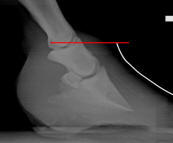
Front right March 07
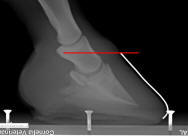
Front Right October 07
She's very happy and comfortable
The DVDs are here and being shipped out now!
New articles posted 8-17-07
"Hoof Care for Angular Deformities"
"Wall Cracks"
2007 · research paper
Laminitis induced by high insulin levels!
New paper from University of Queensland will finally make the entire world place primary focus on diet and exercise for preventing and treating laminitis. See Laminitis Update in the "Articles" section on this site.
Ultimate learning experience for horse owners and professionals: https://www.nolaminitis.org/
Book reviews and introduction
We posted some reviews of the new book here and the Introduction (including Bare vs. Shod discussion) here.
New caudal foot study/poster from Dr. Taylor
Thrush treatment tool
Great new thrush tool!!!
You've gotta see this: Peripheral loading ouch!
"I am currently taking a series of online equine nutrition courses from Eleanor Kellon, VMD www.drkellon.com .
I can't begin to tell you how impressed I am and how much I'm getting out of it! Anyone who is responsible for taking care of horses should join me over there!" Pete
Under the Horse reviews
See what Hoof Professionals and Horse Owners are saying about our DVD series
"Must read" laminitis paper!
Read this! https://www.thehorse.com/ViewArticle.aspx?ID=10256
Check out this video from Joe Camp; the creator of Benji and The Soul of the Horse. This is Paddock Paradise at its best!
Very nice and concise article every horse owner should read: thehorse.com/ViewArticle.aspx?ID=9587
The two day clinics meet the requirements for 20.00 hours of continuing education credit
for veterinarians and 20.00 hours of continuing education credit for veterinary technicians in jurisdictions which recognize AAVSB's RACE approval program, including California.
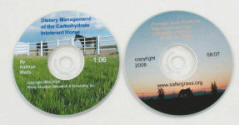
Study www.safergrass.org and watch these new videos. Great help for horses everywhere.
Left hand knife, right hand knife and a hoof pick; all in your hand at the same time!
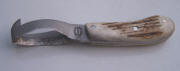
Hand made; one at a time. $150 Contact the knife maker directly: www.solidrockknives.com
Saddle Fitting from A to Z
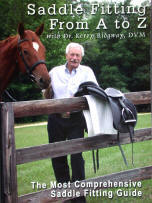
Saddle fit can make or break your horse's performance, health, even hooves. Here's a video your horse needs you to see.
More from Dr. Kerry Ridgway:
- Institute for Equine Therapeutic Options — educational archive
- Equine Therapeutic Options — online teaching, including the separate Equine GastroIntestinal Ulcer Syndrome (EGUS) course.
Dr. Kerry Ridgway also contributed chapters to Care and Rehabilitation of the Equine Foot.